.png)
Dance Like No One Is Watching
- Anthony Donnelly
- May 3
- 5 min read

The Death Of The Moment.
Why the Dance Floor Needs To Ban the Mobile.

There is something unique

about being over forty in this modern world. We are the last of a species that knows exactly what life felt like pre and post mobile phone.
We saw the internet arrive, but more specifically, we saw the mobile phone crawl out of the tech labs and into the sky above our dance floors, eclipsing the soul of the culture.
The harmony of a mock ritual, a room full of people locked into a rhythm of trance, has been traded for a constant crave for social credits and self-promotion. The hot vibration is gone, replaced by the glow of a thousand screens.
Let me pedal back
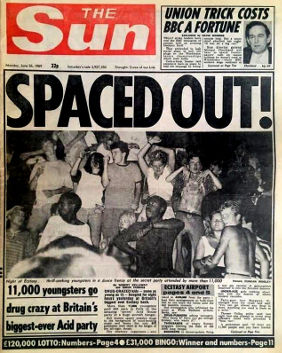
1989. Great Britain was shaking off the reign of Thatcher and the violence of the football terraces.
In North America, we were exiting a messy decade where nobody really knew what the fuck was going on with music or culture. We were done with neon and we couldn't take any more cheese. Then, out of nowhere, the Ecstasy Rave generation hit like a cyclone.
It sucked up everyone in its path and kept us spinning in an eternal feeling of harmony. Culture was alive. Counter-culture was alive. You saw kids from the backstreets of Manchester to the alleys of Detroit, Toronto, and London all unified. And one thing you didn't see was a mobile phone.

As someone with a history in events coordinating / rave promoter,
architecting these underground spaces, Occasionally, a media outlet would try to bring a camera in. To their surprise, they were denied every single time. There was no way a camera was getting near that dance floor. Why? Because you had to be there.
What was happening in those rooms was sacred, and frankly, there was enough shit going on that could put you away for a few years. It was a different time. Technology is a marvel, but on the dance floor, the mobile phone is the enemy.

Over in the UK, the birthplace of the modern rave, they’ve been sounding the alarm on this for years.
Heavyweight venues like "FOLD" in London have already implemented strict no-photo policies. They realized that when the red record lights start popping up, the anonymity that makes a club feel safe disappears. People stop being participants and start being spectators. The British scene has always been about the collective "we," and they know that a sea of glowing screens turns that "we" into a bunch of isolated "I’s" looking for a digital pat on the back.
This isn't just a hunch from the old guard either
A recent study out of the UK shows that more than half of all clubbers actually think phones are ruining the experience. People are starting to wake up to the fact that you can't be fully immersed in the music when you're looking through a five-inch screen. Even the younger generations are beginning to crave those "phone-free" zones because they want to feel that raw energy that we took for granted. They are realizing that the best nights are the ones you can't prove happened with a photo.
There is actual science behind why this ruins the night.

When you pull out a phone to capture a "moment," you trigger a psychological shift called "media-induced forgetting." By focusing on framing the shot, your brain stops fully processing the sensory experience of the music and the atmosphere.
You aren’t actually experiencing the high, you’re just documenting the shell of it. It kills the "flow state," that collective trance where everyone in the room moves as one. Once the ego of the lens enters the room, the raw, unfiltered human connection is severed by the glass.
The underground used to be an anti-camera environment. It was where you went to escape the mainstream and get down to business. You’d lock into a vibration and forget about life for eight hours, never once thinking about an ego-driven status update.
Now, the phone is an extension of our arms. It’s impossible not to have one. We have all our eggs in one basket, from banking to family. But its impact on the dance floor has been nothing but negative. I’m not a technophobe. I thrive on new formats and engagement. I wake up and check my likes just like the next person. But on the dance floor? Get that thing away from me.
We’ve traded living in the moment for trying to prove to others that we are in the moment. It’s a total oxymoron. There is no moment anymore, just a big picture of people trying to capture one. It’s a vibration killer that has stripped the identity right off the scene. If you didn’t know life on the floor before the phone, you don’t know what you’re missing.
A few years ago in the UK, I saw a massive outcry for venues to ban the mobile. This isn't about turning back time, it's about letting the next generation have a positive, raw experience. You shouldn't have to worry about looking good or checking emails when you're four-to-the-floor. There’s an old saying that you should dance like nobody is watching. Well, with a phone on the dance floor, everyone is watching. And there goes the moment.

I was buzzing to read the headlines recently about Toronto finally following suit. A new spot called Complex19 is opening downtown in the old Courthouse space on Adelaide Street. They are taking a stand with a "no phone cameras" policy. No booths, no bottle service, just 8,000 square feet dedicated to music and dancing.
It’s a three-level club trying to bring back the atmosphere where people actually move instead of filming the night. It’s about time we stop the social disaster and get back to the ritual.
I am not saying
the dance floors were bigger and better back in my day, or that newer dance cultures that have formed in the presence of mobile devices are any lesser. I'm not shunning any modern dance floor revelers that don’t know the floor any different without the device.
What I am saying is, having the moral compass of life pre and post mobile phone, for the modern mobile cultured floors, removing the mobile from the moment will only have a positive experience for the current floors and movements to come.
A mandatory mobile check-in, like a coat check, will no doubt heighten the actual moment and experience for the integrity of the scene. The focal point gets back to the actual music and performers.
More importantly, it puts you in the real moment.
We can pick up the bullshit moment on the way out at the phone check when we go back to the entirety of the rest of the day taking selfies
Ants / BDM


Comments